📌 Quick Summary
The technology landscape is undergoing a massive transformation powered by hardware-level artificial intelligence integration and next-generation mobile silicon. Today’s updates highlight breakthroughs in ARM-based personal computing, advanced foldable smartphone displays, and deep AI integrations across major operating systems like Android and iOS. Simultaneously, global semiconductor supply chains face new geopolitical dynamics as tech conglomerates double down on custom silicon architectures. From mobile platform milestones to enterprise software optimizations, this comprehensive report covers critical product launches, ecosystem updates, and strategic industry realignments reshaping how consumers and enterprises interact with technology across the globe.
Table of Contents
New Gadgets & Hardware Innovations
The consumer electronics market is experiencing a profound pivot as hardware manufacturers move beyond mere spec upgrades to focus heavily on localized artificial intelligence processing. Today’s hardware launches underscore a growing preference for low-latency, on-device AI accelerators alongside radical hardware form factors.
ARM-Based Computing Gains Explosive Momentum
The personal computer landscape is witnessing its most dramatic structural shift in decades. Laptops equipped with Qualcomm’s Snapdragon X Elite and Snapdragon X Plus silicon are now hitting consumer markets at scale, delivering competitive performance-per-watt metrics that directly challenge x86 architecture dominance. According to reporting from The Verge, OEMs like Lenovo, Dell, and HP are expanding their flagship ultraportable lineups with integrated Neural Processing Units (NPUs) capable of over 45 TOPS (Trillions of Operations Per Second).
These hardware advances enable real-time device translation, localized image generation, and background contextual processing without requiring heavy cloud roundtrips. As battery life expectations jump to 20+ hours of continuous usage, legacy processor manufacturers are accelerating their own low-power, NPU-heavy architectures to retain enterprise market share.
Foldable Form Factors and Multi-Fold Displays
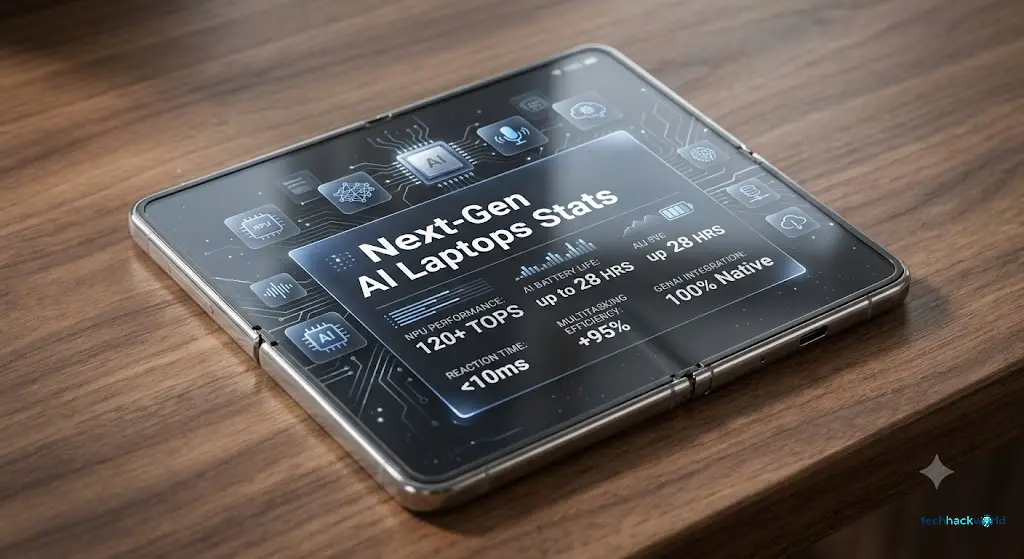
Flexible display technology has matured from an experimental novelty into a mainstream premium tier. Display panel manufacturers have successfully reduced creasing, improved hinge durability, and integrated ultra-thin glass (UTG) solutions that withstand over 500,000 fold cycles. Beyond standard book-style foldables, manufacturers are demonstrating commercial prototypes of dual-hinge, tri-fold devices that convert a standard 6.5-inch smartphone screen into a full-sized 10-inch workspace tablet.
In parallel, wearable tech is absorbing advanced health sensors, including continuous non-invasive bio-metric trackers and optical pulse sensors optimized by machine learning algorithms to filter out motion artifacts during intensive user activity.
Hardware Comparison Table
| Device Category | Key Chipset / Processor | NPU Capability | Primary Use Case |
|---|---|---|---|
| Next-Gen AI Laptops | Qualcomm Snapdragon X Elite | 45 TOPS | On-device LLMs, extended battery productivity |
| Tri-Fold Smartphones | Custom Octa-Core 3nm SoC | 38 TOPS | Multi-window productivity, pocket tablet form factor |
| Smart Wearables | Ultra-Low-Power Dual-Core MCU | 10 TOPS | Continuous health diagnostics, ambient voice assistant |
Software & OS Updates
On the software front, major operating systems are deploying comprehensive updates centered around security, contextual awareness, and deep generative AI integration at the system level.
Android Platform Refinements and Privacy Vaults
Google’s incremental platform rollouts are doubling down on user privacy controls and ambient intelligence. As documented on the official Android Developers platform, the latest operating system updates introduce a secure “Private Space” environment. This sandboxed layer allows users to isolate sensitive banking, healthcare, and messaging apps behind an additional layer of biometric authentication, completely hiding them from launcher search routines and notification logs.
Additionally, satellite messaging functionality is now natively embedded into the OS connectivity stack, enabling standard SMS communications over Non-Terrestrial Networks (NTN) when cell towers are out of reach. Predictive back-gestures and automated battery optimization hooks further refine the user experience on both standard glass slabs and foldable layouts.
Apple Intelligence and iOS System Overhauls
Apple continues the phased deployment of its native intelligence layer across iOS, iPadOS, and macOS. Deeply integrated into the system framework, Apple Intelligence combines on-device models with Private Cloud Compute to handle complex linguistic and visual queries. Siri has received a massive contextual update, enabling intent-matching across multiple third-party and first-party applications simultaneously.
System-wide writing tools now allow users to rewrite, proofread, and summarize text natively across any text box, while generative image utilities are tied directly into messaging and notes apps. Crucially, strict privacy protections ensure data processed in the cloud is never saved or accessible to third parties, setting a competitive baseline for security-conscious enterprise environments.
Windows System Enhancements and AI Workflows
Microsoft’s desktop platform is rolling out security-hardened updates to its Copilot ecosystem. Following feedback regarding local data indexers, privacy safeguards have been rebuilt to ensure locally captured activity snapshots are encrypted using device-bound cryptographic keys. Content creation software—such as Paint, Photos, and video editing suites—now relies on localized NPU processing to perform instant background removal, upscaling, and style transfers without drawing on remote server bandwidth.
Tech Industry & Market Shifts
Beyond consumer products, macro trends in semiconductor manufacturing, regulatory enforcement, and AI infrastructure are reshaping global market balances.
Semiconductor Supply Chains and Foundry Dynamics
The global race for semiconductor sovereignty remains intense. Leading silicon foundries are rapidly ramping up production for 2-nanometer process nodes, leveraging High-NA EUV (Extreme Ultraviolet) lithography systems. According to industry reports published by Reuters, major cloud service providers are increasingly designing proprietary custom silicon to lower operating expenses associated with commercial AI graphics processors.
This vertical integration trend is driving massive capital expenditure into custom ASIC development, reducing reliance on third-party chip suppliers while accelerating specialized accelerator deployments across data centers globally.
Regulatory Frameworks and App Ecosystems
Global regulatory bodies continue to scrutinize digital marketplace monopolies and platform gatekeeping. Enhanced enforcement of antitrust frameworks in both Europe and Asia has forced major ecosystem operators to open their app distribution platforms, allow third-party web rendering engines, and provide unbundled payment pathways for developers.
Market updates covered by TechCrunch reveal that cross-platform interoperability, alternative app stores, and unbundled service bundles are gaining traction, allowing independent software vendors greater flexibility to monetize digital products without paying heavy commission rates.
Frequently Asked Questions
What are the main benefits of ARM-based laptops over traditional x86 laptops?
ARM-based laptops offer significantly higher power efficiency, allowing for 18 to 22 hours of real-world battery life without sacrificing compute speed. They run cooler, often require fanless thermal designs, and feature integrated NPUs designed specifically to execute local AI tasks efficiently.
How does on-device AI differ from cloud-based AI processing?
On-device AI processes prompts, images, and data directly on the local hardware processor (NPU). This ensures faster response times, eliminates the need for an active internet connection, and drastically enhances user privacy since personal data never leaves the physical device.
Will old mobile applications work smoothly on the new mobile OS updates?
Yes. Both Apple and Google enforce backward compatibility standards. Apps targeting older API levels run within translation layers or compatibility containers. However, to utilize new AI toolkits, private sandboxes, and satellite connectivity, developers must release native app updates.
What is a Neural Processing Unit (NPU) and why is it essential for modern gadgets?
An NPU is a specialized microprocessor optimized specifically for accelerating neural network operations and machine learning algorithms. Unlike CPUs or GPUs, NPUs are designed to handle complex mathematical calculations for AI models while consuming a fraction of the battery power.