📌 Quick Summary
Today’s global technology landscape is defined by rapid hardware-software convergence, driven primarily by generative AI integration. From Apple’s M4 chip architecture expanding across its device portfolio to Google’s stabilized Android 15 ecosystem, ambient computing is moving from concept to everyday reality. Hardware manufacturers are simultaneously pivoting toward lightweight AI-enabled wearables, smart glasses, and specialized neural processing units (NPUs). Meanwhile, the global semiconductor supply chain faces strategic realignments amid soaring enterprise demand for datacenter compute. Read our comprehensive report for detailed specs, software breakdowns, and key industry forecasts shaping the digital landscape today.
Table of Contents
The consumer technology landscape is experiencing a fundamental structural evolution. Driven by advances in high-efficiency neural processing, hyper-localized artificial intelligence models, and revised semiconductor architectures, hardware manufacturers and software developers are racing to redefine human-computer interaction. As reported by major trade outlets like TechCrunch, the boundary between local silicon capabilities and cloud compute is rapidly blurring, giving rise to an era dominated by contextual, always-on device intelligence.
Today’s comprehensive roundup examines the newest consumer devices reaching the market, the definitive operating system updates reshaping mobile and desktop experiences, and the strategic economic forces governing the global tech industry.
New Gadgets & Hardware Innovations
Hardware release cycles in late 2024 and early 2025 have pivoted dramatically around single primary metric: local execution capability for AI workloads, measured in TOPS (Trillions of Operations Per Second). From flagship desktop computing to ambient wearable devices, silicon manufacturers are shipping silicon designed from the ground up for low-latency neural processing.
The Silicon Arms Race: M4 Architecture vs. Ultra-Mobile Competitors
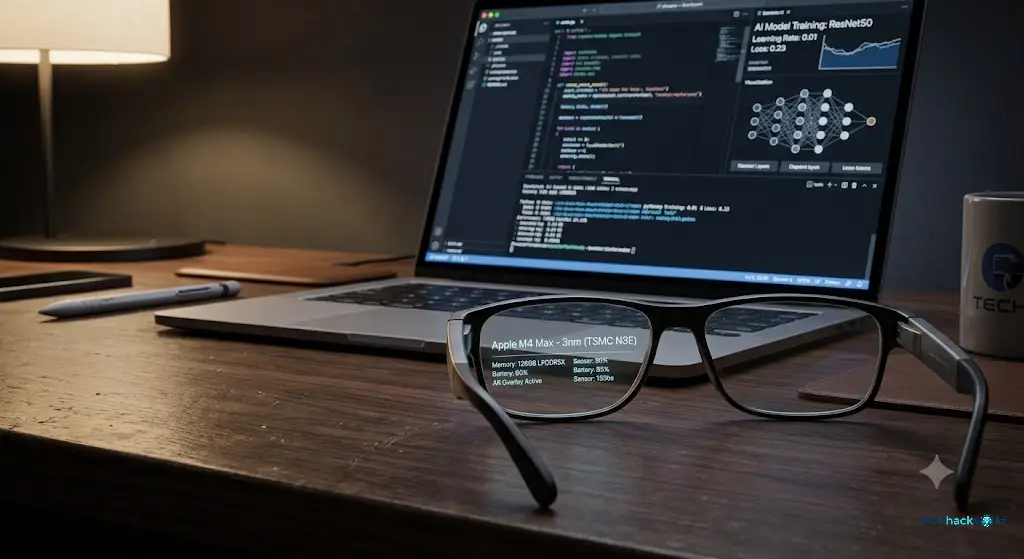
Apple has completed another critical milestone in its custom silicon transition by cascading the M4 family—including the M4 Pro and M4 Max chips—across its computing lineup. Built on TSMC’s second-generation 3-nanometer process, the M4 architecture delivers up to 38 TOPS of neural processing speed. This raw hardware power directly enables complex on-device task automation via Apple’s recent engineering platform announcements, reducing reliance on distant cloud servers.
Concurrently, Qualcomm and Intel are challenging Apple’s long-standing dominance in battery efficiency. Qualcomm’s Snapdragon X Elite platform and Intel’s Core Ultra Series 2 (Lunar Lake) chips are forcing a complete overhaul of the Windows laptop category. Both platforms integrate dedicated NPUs exceeding the 40 TOPS benchmark required for native Copilot+ PC experiences.
Ambient Computing Gains Traction: Next-Gen Smart Glasses
Wearable technology is moving beyond basic fitness tracking and biometric monitoring toward multimodal ambient assistants. The success of the Ray-Ban Meta Smart Glasses has validated a new category: display-less, audio-first AI wearables. Featuring real-time multimodal processing, these devices allow users to ask questions about their physical surroundings, translate spoken language instantly, and capture ultra-high-resolution media hands-free.
Industry competitors are swiftly responding. Rivals are developing minimalist smart frames incorporating micro-OLED heads-up displays, optical wave-guides, and low-power spatial audio systems. The ultimate goal is delivering contextually relevant data directly into the user’s field of view without requiring a conventional smartphone interaction.
Next-Gen Laptop & Mobile Processor Specifications
To understand how the leading hardware platforms compare, consider the baseline architectural metrics of today’s dominant mobile and desktop chipsets:
| Processor Model | Architecture / Node | NPU Performance (TOPS) | Primary Hardware Focus |
|---|---|---|---|
| Apple M4 Max | 3nm (TSMC N3E) | 38 TOPS | On-Device LLM Execution & Pro Media Workflows |
| Qualcomm Snapdragon X Elite | 4nm (TSMC N4P) | 45 TOPS | Ultra-Efficient Windows AI Laptops |
| Intel Core Ultra 9 (Series 2) | 3nm (TSMC N3B) | 47 TOPS | x86 Efficiency & High-Performance AI Compute |
| AMD Ryzen AI 9 HX 370 | 4nm (TSMC N4) | 50 TOPS | Mobile Workstation Graphics & Generative AI |
Software & OS Updates
Hardware is only as effective as the operating system driving it. Today’s major software platforms are undergoing their most radical user-interface and background system architectural redesigns in over a decade.
Android 15: Security Core and Local AI Foundations
Google has officially begun the broad platform rollout of Android 15 across flagship Android devices. While visual changes appear subtle at first glance, the underlying security infrastructure and engine performance have been substantially enhanced.
- Private Space: Users can now create a isolated, hardware-encrypted environment inside their device to protect sensitive applications and confidential documents behind secondary biometric authentication.
- Theft Detection Lock: Utilizing machine learning algorithms and accelerometer data, Android 15 automatically locks the handset screen instantly if it detects motion patterns associated with snatch-and-run theft.
- Optimized Gemini Nano Integration: Deep system-level integration enables low-latency contextual summaries, predictive text creation, and image processing locally without transmitting data to public networks, as detailed on the Android Developers Portal.
iOS 18.2 Expansion: Contextual Intelligence Arrives
Apple’s gradual rollout of Apple Intelligence features continues with the release of iOS 18.2. This update brings critical missing features promised during initial software previews, expanding localized AI capabilities to millions of compatible iPhone 15 Pro and iPhone 16 series users globally.
Key highlights include Visual Intelligence—which allows users to point their camera at real-world objects or storefronts to obtain instant search summaries—and direct integration between Siri and third-party AI platforms like ChatGPT. Crucially, Apple’s system retains strict privacy boundaries by masking user IP addresses and ensuring search queries sent to external services are not stored or indexed for model training.
Windows 11 Version 24H2: Rebuilding for ARM and Copilot
Microsoft’s Windows 11 24H2 update marks a major turning point for the OS platform, particularly for x86 emulation on ARM architectures via the improved Prism engine. Beyond architectural optimization, Microsoft has overhauled its controversial “Recall” feature following rigorous security revisions. Recall now operates purely as an opt-in experience featuring mandatory Windows Hello biometric authorization, hardware-encrypted database storage, and full exclusion control over specific apps and sensitive browser sessions.
Global Tech Industry Shifts
Behind these consumer product rollouts lie massive structural realignments within semiconductor manufacturing, geopolitics, and corporate AI investments. Global market reports monitored by financial authorities like Reuters Technology indicate that the technology ecosystem is navigating unprecedented infrastructural strain and geopolitical maneuvering.
The Semiconductor Bottleneck: Advanced Packaging & EUV Supremacy
The global demand for high-performance AI accelerators has shifted the market focus from basic silicon wafer fabrication to advanced semiconductor packaging. TSMC’s CoWoS (Chip-on-Wafer-on-Substrate) capacity remains severely constrained, limiting the production volumes of specialized enterprise hardware from companies like NVIDIA, AMD, and custom ASIC vendors.
To maintain market leadership, major foundries are accelerating their transition to High-NA EUV (High Numerical Aperture Extreme Ultraviolet) lithography tools manufactured by ASML. These multi-hundred-million-dollar machines allow semiconductor manufacturers to print transistor features at physical sizes down to 1.4 nanometers (A14 process nodes), unlocking higher clock speeds while drastically scaling down thermal energy requirements.
Enterprise AI Monetization vs. Infrastructure Capex
Hyperscalers including Microsoft, Alphabet, Amazon Web Services, and Meta are spending hundreds of billions of dollars combined on data center construction, liquid cooling retrofits, and specialized power infrastructure. However, financial markets are increasingly demanding clear paths to profitability for consumer-facing generative AI tools.
As a result, tech giants are shifting from pure consumer subscriptions toward enterprise workflow automation, API monetization, and localized on-device processing to reduce the cost per query. Moving low-complexity AI requests off cloud servers and onto individual laptops and mobile phones is rapidly transitioning from a user-privacy feature into a vital business operational necessity.
Frequently Asked Questions
What is a Neural Processing Unit (NPU) and why do I need one?
An NPU is a specialized processor built specifically to accelerate artificial intelligence tasks like image recognition, voice processing, and real-time text generation efficiently. Unlike traditional CPUs or GPUs, NPUs complete complex neural network calculations using a fraction of the electrical power, significantly preserving device battery life during continuous AI operations.
Will my existing smartphone receive the latest Android 15 or iOS 18 updates?
Android 15 support varies by device manufacturer, though recent flagship phones from Google, Samsung, Xiaomi, and OnePlus generally offer between four to seven years of guaranteed software support. For Apple devices, iOS 18 is compatible with iPhone XS models and newer, though localized Apple Intelligence capabilities strictly require an iPhone 15 Pro, iPhone 15 Pro Max, or any iPhone 16 model due to elevated RAM and NPU bandwidth demands.
Are on-device AI features safe for user privacy?
On-device AI features are fundamentally more secure than traditional cloud-based processing because your private data—such as personal photos, text messages, and sensitive queries—never leaves physical device memory. When local execution is sufficient, no external servers can log, analyze, or intercept your personal interactions.