📌 Quick Summary
The artificial intelligence landscape is undergoing a monumental shift marked by the rise of specialized reasoning models, competitive open-weight architectures, and heightened global regulatory scrutiny. OpenAI’s reasoning breakthroughs with the o-series, alongside DeepSeek’s high-efficiency R1 architecture and Google’s Gemini 2.0 multimodal ecosystem, are redefining computational efficiency and task autonomy. Meanwhile, enterprise adoption of generative video, autonomous AI agents, and code synthesis tools continues to accelerate. This comprehensive report breaks down the newest model releases, key benchmark comparisons, emerging generative tools, and critical regulatory updates shaping the future of AI.
Table of Contents
Industry Overview & Key Trends
The artificial intelligence sector has transitioned from simple pattern recognition and autocomplete capabilities to deliberate, multi-step logical reasoning and autonomous action. Over the past several months, the core focus of frontier labs has expanded beyond scaling pre-training datasets to optimizing test-time compute—allowing models to think before generating an answer. This paradigm shift has unlocked unprecedented capabilities in complex mathematics, advanced computer programming, and scientific hypothesis generation.
Simultaneously, the open-weight AI ecosystem has caught up with closed-source giants at a speed few anticipated. Open-weights architectures from global research entities are demonstrating that smart algorithmic efficiency, specialized reinforcement learning, and innovative Mixture-of-Experts (MoE) designs can match or exceed proprietary systems at a fraction of the training and inference cost. Platform providers like Hugging Face are seeing record adoption rates as enterprises deploy these high-efficiency models locally and on-premise to maintain data privacy and drastically lower operational expenses.
As autonomous AI agents begin taking over complex desktop and enterprise workflows, the line between software utility and synthetic intelligence is blurring. In this article, we examine the newest model releases, quantify their performance through empirical benchmarks, review groundbreaking generative production tools, and analyze the shifting global policy ecosystem.
New Model Releases & Reasoning Architectures
The latest generation of Large Language Models (LLMs) represents a qualitative leap in architectural sophistication. Below is an overview of the defining releases that are reshaping the research landscape today.
DeepSeek-R1 and the Open-Weight Efficiency Movement
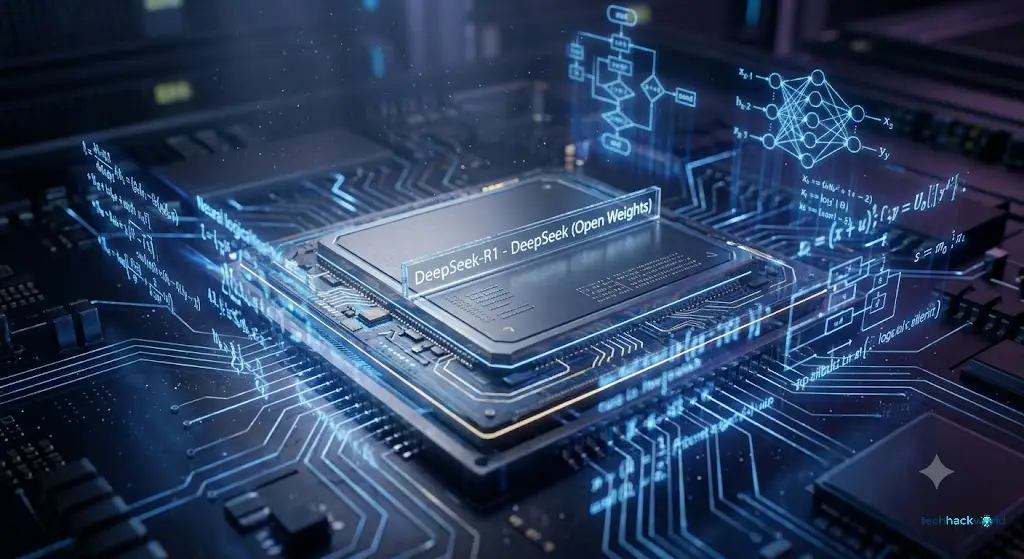
China’s DeepSeek research lab sent shockwaves through the tech industry with the release of DeepSeek-V3 and its specialized reasoning variant, DeepSeek-R1. Built upon a Mixture-of-Experts (MoE) architecture utilizing Multi-head Latent Attention (MLA), DeepSeek-R1 proves that competitive reasoning models can be trained without multi-billion-dollar infrastructure budgets. By employing large-scale Reinforcement Learning (RL) without relying exclusively on massive supervised fine-tuning (SFT) datasets, DeepSeek-R1 incentivizes the model to generate self-correcting chains of thought. Its performance on mathematical and algorithmic benchmarks matches proprietary closed-source reasoning systems while providing public access to open model weights published on repositories hosted across research networks and research repositories on arXiv.
OpenAI o1 and o3 Frontiers
OpenAI has fundamentally altered model paradigm scaling with its “o” series models—most notably o1 and the newly unveiled o3 family. Unlike traditional autoregressive LLMs that generate the next token immediately based on context, these reasoning models utilize test-time compute. They generate extensive internal hidden chains of thought before delivering a final response. This allows the system to backtrack, explore alternative problem-solving pathways, and verify internal logic. OpenAI o3 has achieved landmark scores on competitive programming platforms such as Codeforces and upper-echelon math olympiads like AIME, setting a new bar for synthetic logical capabilities.
Google Gemini 2.0 Ecosystem
Google officially introduced Gemini 2.0 Flash and Gemini 2.0 Pro, pushing the boundary of native multimodality and agentic integration. Designed from the ground up to process audio, video, text, and code streams concurrently without relying on separate modality wrappers, Gemini 2.0 offers low-latency real-time voice interaction alongside native spatial and visual comprehension. Google has integrated these systems deeply into developer workflows and search architectures via OpenAI-style developer APIs and Google Cloud Vertex AI, making real-time agentic vision assistance a practical reality.
Anthropic Claude 3.5 Sonnet and Computer Use
Anthropic continues to refine developer-centric capabilities with updates to its Claude 3.5 platform, including the groundbreaking “Computer Use” feature. Claude 3.5 Sonnet can interpret desktop screen inputs, move cursors, click buttons, and execute shell commands natively. This capability shifts LLM usage from text-in/text-out prompting to end-to-end task execution across arbitrary desktop software interfaces, marking a significant milestone toward functional general-purpose AI agents.
Benchmark Comparison & Technical Analysis
Evaluating modern reasoning and generative models requires moving past legacy benchmarks like MMLU (Massive Multitask Language Understanding), which many modern frontier models have virtually saturated. Industry benchmarks now focus heavily on advanced competition mathematics (AIME 2024), PhD-level scientific problem solving (GPQA Diamond), software engineering tasks (SWE-bench Verified), and raw code synthesis (HumanEval).
The table below provides a side-by-side performance snapshot of today’s top frontier models across standard industry benchmarks:
| Model Name | Developer / Source | AIME 2024 (Math) | GPQA Diamond (Science) | SWE-bench Verified (Coding) | HumanEval (Python) | Primary Architecture |
|---|---|---|---|---|---|---|
| DeepSeek-R1 | DeepSeek (Open Weights) | 79.8% | 71.5% | 49.2% | 92.8% | MoE + Test-Time RL |
| OpenAI o3-mini | OpenAI (Proprietary) | 87.3% | 77.2% | 52.8% | 95.1% | Test-Time Compute Reasoning |
| Gemini 2.0 Flash | Google (Proprietary) | 62.1% | 64.8% | 38.5% | 89.4% | Native Multimodal Dense |
| Claude 3.5 Sonnet | Anthropic (Proprietary) | 64.5% | 65.0% | 49.0% | 93.7% | Dense Autoregressive Transformer |
The technical takeaway from recent data is clear: reasoning models employing test-time inference scaling (such as OpenAI o3 and DeepSeek-R1) dramatically outperform standard autoregressive transformers on structured logic tasks like AIME and SWE-bench. However, for direct instruction-following, rapid dynamic conversational responses, and real-time multimodal processing, standard dense or MoE models like Gemini 2.0 Flash and Claude 3.5 Sonnet maintain superior speed-to-cost efficiency profiles.
Generative AI Tools & Enterprise Features
While foundation models represent the core engine of modern AI, the application layer is rapidly evolving across visual media, enterprise orchestration, and automated software development.
Hyper-Realistic Video Generation
Generative video has progressed from low-resolution, warped outputs to cinema-grade output within months. OpenAI’s Sora, Runway’s Gen-3 Alpha, and specialized open video tools have integrated advanced physical world simulation. Creators can now control camera pan, zoom, atmospheric lighting, and temporal consistency across multiple prompt steps. These tools are fundamentally disrupting post-production workflows, pre-visualization phases in film studios, and digital marketing pipelines.
AI-Driven Software Development Environments
Software development is experiencing its most radical transformation since the invention of the integrated development environment (IDE). Autonomous coding agents like Devin, Cursor, and GitHub Copilot Workspace do not merely complete line prompts; they ingest entire software repositories, analyze dependency graphs, reproduce bugs from error logs, create feature branches, and automatically submit comprehensive pull requests for human review.
Enterprise Agent Frameworks
Frameworks such as LangChain, AutoGen, and CrewAI have matured into production-grade orchestration platforms. Enterprises are deploying multi-agent systems where dedicated digital roles—such as Data Analyst, Security Auditor, and Content Localization Specialist—communicate via structured API calls to perform end-to-end business operations with minimal human intervention.
AI Ethics, Policy, and Global Regulation
The rapid escalation of synthetic capabilities has accelerated worldwide legislative efforts aimed at mitigating systemic risks, protecting intellectual property, and ensuring data privacy.
The European Union’s AI Act has begun entering its active implementation phase, introducing mandatory risk management framework tiers for General Purpose AI (GPAI) models. Developers operating models with significant systemic impact must publish comprehensive technical documentation, comply with EU copyright laws during data scraping, and reveal detailed energy consumption profiles. Organizations seeking compliance guidance frequently align their technical architectures with security standards provided by bodies like the NIST AI Risk Management Framework.
In the United States, federal agencies continue to enforce strict scrutiny regarding consumer protection, copyright infringement, and algorithmic bias. The legal fight surrounding training data usage remains intensely contested in federal courts, where content creators, publishers, and visual artists are litigating fair-use exemptions claimed by AI labs. Simultaneously, technical standard bodies are pushing for widespread adoption of digital provenance standards, such as C2PA cryptographic watermarking, to combat deepfakes, automated disinformation campaigns, and media falsification during election cycles globally.
Frequently Asked Questions
What is test-time compute and why is it important for new LLMs?
Test-time compute refers to allocating additional computational resources during the model’s inference phase (when it generates an answer) rather than solely during pre-training. By allowing a reasoning model like OpenAI o3 or DeepSeek-R1 extra “thinking time” to run internal chains of thought, evaluate multiple options, and correct logic errors before giving a final output, performance on highly complex mathematical and coding problems increases exponentially.
How do open-weight reasoning models like DeepSeek-R1 compare to closed-source options?
Open-weight models like DeepSeek-R1 offer performance that rivals proprietary models on benchmarks such as AIME and HumanEval, but with lower training and execution costs. They allow developers to inspect, fine-tune, host, and run the models on private infrastructure without sending data through third-party APIs, making them ideal for enterprise adoption where privacy and cost control are paramount.
What are the legal compliance requirements under the EU AI Act for AI developers?
The EU AI Act classifies AI systems by risk tier. Developers of General Purpose AI models must provide detailed technical documentation, submit compliance summaries regarding training data sources, adhere to copyright regulations, and implement cybersecurity protections. High-risk application areas (like hiring algorithms, biometrics, or critical infrastructure) are subject to conformity assessments and continuous post-market audits.
How are autonomous AI agents different from traditional chatbots?
Traditional chatbots simply accept text input and output generated text in a single step. Autonomous AI agents, by contrast, possess tools, memory, and reasoning capabilities. They can break down high-level instructions into multi-step execution plans, browse the web, write and run code, execute terminal commands, and interact with third-party software APIs independently until a given objective is met.