By Naveen Yadav | Founder, Tech Hack World
Let’s be completely honest for a second. If you look at the news right now, it feels like every other day a major corporation is dealing with a massive data breach, ransomware attack, or server compromise.
The digital world is expanding fast, but the security around it? It’s struggling to keep up.
This gap has created one of the most massive demands for skilled professionals we’ve ever seen. But if you are sitting at home right now, staring at your screen and wondering, “How do I actually get into cyber security?” the whole thing can feel incredibly overwhelming.
Do you need a computer science degree? Do you need to be a math genius? Which programming language should you learn first?
Welcome to the first official post on the Tech Hack World blog. Today, we are going to cut through the noise. Here is your practical, no-nonsense roadmap to starting a career in cyber security in 2026.
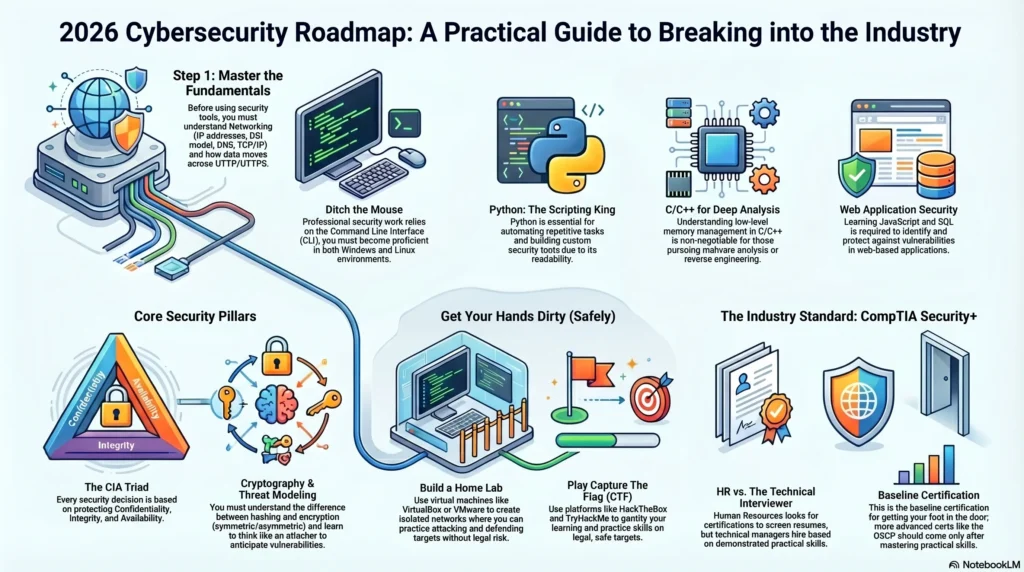
Step 1: Stop Trying to Hack on Day One
The biggest mistake beginners make is jumping straight into “how to hack.” They download Kali Linux, run a few automated tools they don’t understand, and call it a day.
You cannot secure (or ethically hack) a system if you don’t know how it works in the first place. Before touching any security tools, you need to build a foundation.
What you need to learn first:
- Networking Basics: How do computers talk to each other? You need to understand IP addresses, the OSI model, DNS, TCP/IP, and HTTP/HTTPS. If you don’t know how data moves, you won’t know how to intercept or protect it.
- Operating Systems: Get very comfortable with both Windows and Linux. Learn how to use the command line interface (CLI). A good security professional rarely relies on a mouse.
Step 2: Learn to Read and Write Code
There is an ongoing debate online about whether you need to know how to code to be in cyber security. Let me settle this: Yes, you do. While there are some non-technical compliance roles out there, if you want to be a penetration tester, malware analyst, or security engineer, you have to understand code. Otherwise, how will you find vulnerabilities in an application?
Where to start:
- Python: This is the undisputed king of cyber security scripting. It’s easy to learn, easy to read, and allows you to automate repetitive tasks or build your own security tools.
- C/C++: If you want to get into malware analysis or reverse engineering, understanding how memory works at a low level is non-negotiable.
- JavaScript & SQL: Essential if you want to protect (or test) web applications.
(Note: If you’re stuck here, this is exactly why we built the programming courses at Tech Hack World. We teach you exactly what you need to know, without the unnecessary academic fluff).
Step 3: Understand the Core Security Concepts
Once you know how networks and applications are built, you can start learning how they are broken.
Familiarize yourself with the core pillars of security:
- The CIA Triad: Confidentiality, Integrity, and Availability. Every security decision traces back to this.
- Cryptography: You don’t need to invent new math, but you need to know the difference between hashing, symmetric encryption, and asymmetric encryption.
- Threat Modeling: Learning how to think like an attacker to anticipate where the vulnerabilities might be.
Step 4: Get Your Hands Dirty (Safely)
Reading theory will only get you so far. Cyber security is a hands-on sport. You need practical experience to land a job.
How do you get experience without getting arrested?
- Set up a Home Lab: Use virtual machines (like VirtualBox or VMware) to create a safe, isolated network on your own computer. Practice attacking and defending your own virtual targets.
- Play CTFs (Capture The Flag): Platforms like HackTheBox and TryHackMe are incredible for beginners. They gamify the learning process, giving you legal, safe targets to practice your skills on.
Step 5: Certifications vs. Skills
When you apply for your first job, HR will look for certifications, but the technical interviewer will look for actual skills. You need a balance.
If you are just starting, the CompTIA Security+ is the industry standard for getting your foot in the door. It proves you understand the vocabulary and core concepts of the industry. Later on, you can aim for practical certifications like the OSCP, but don’t rush it. Focus on the skills first, and the certs will follow.
The Bottom Line
Starting a career in cyber security isn’t going to happen overnight. It requires patience, a lot of late nights reading documentation, and a genuine curiosity for how technology works.
But if you are willing to put in the work, it is one of the most rewarding, high-paying, and secure career paths available today.
Ready to stop reading and start doing? At Tech Hack World, we skip the boring theory and dive straight into what actually matters in the real world. Whether you need to learn your first programming language or want to dive deep into network security, we have a course built for you.
Check out our Course Catalog to start your journey today.
Make sure to bookmark this blog! We’ll be posting daily tips, code snippets, and security news to keep your skills sharp.